Overview
Objective and scope
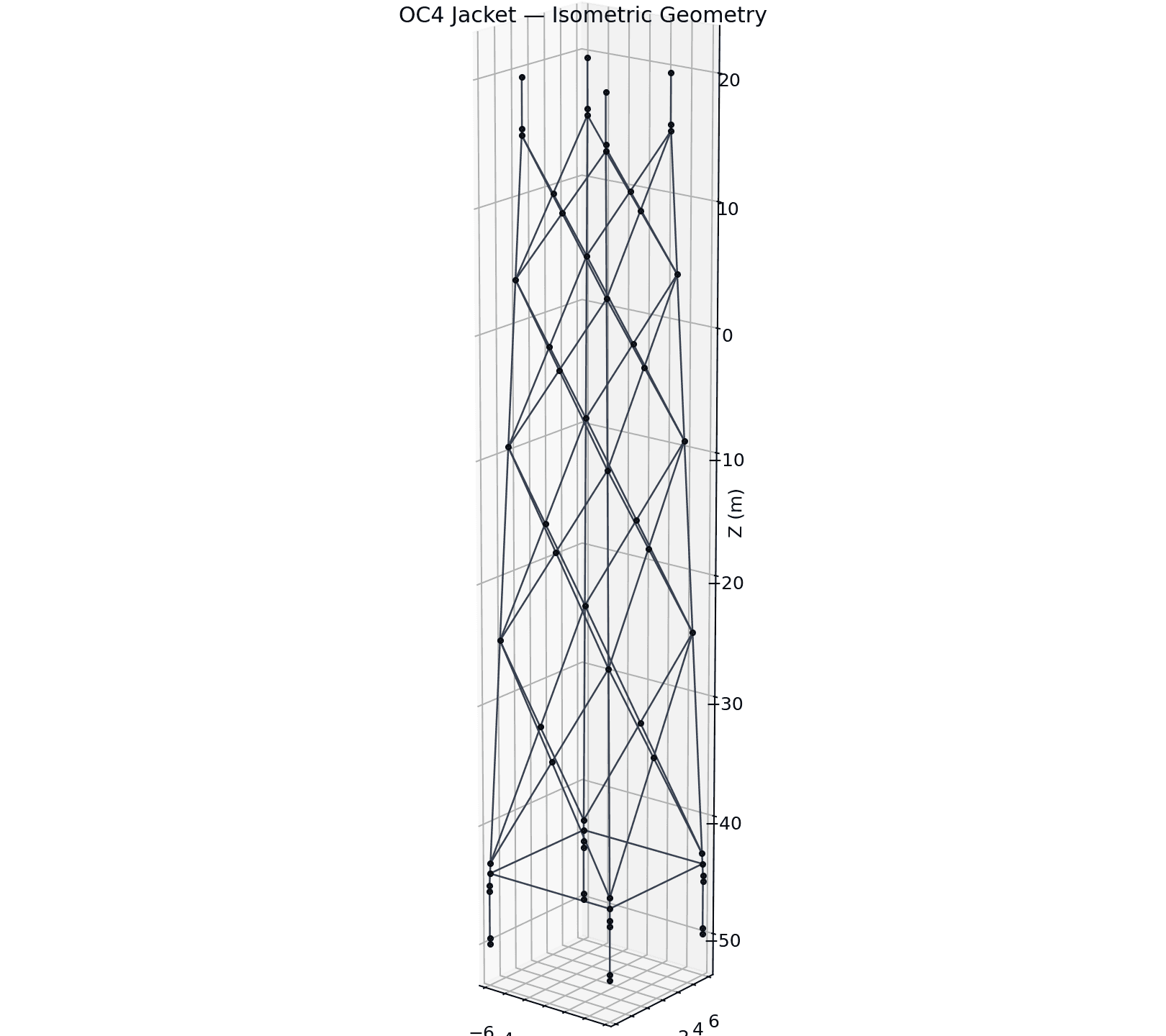
This is a learning and reproducibility study, not a claim to have designed OC4. Immutable OpenFAST/SubDyn reference inputs were audited, parsed, and mapped into an independent fixed-base BEAM188 model so topology, connectivity, sections, loads, and verification evidence could be studied transparently.
Engineering question
Reference-model inputs are easy to misrepresent when structural source data, solver assumptions, and result classifications are not kept separate. This project preserves that boundary from source inventory through final reporting.
Objectives
- Interpret retained OC4 OpenFAST/SubDyn inputs without modifying the source snapshot.
- Build a traceable beam-model representation of geometry, connectivity, supports, sections, and materials.
- Keep source-derived, verification, and supplemental sensitivity outputs distinct in the final evidence pack.
Method
How the work was approached
- Record selected source inputs, dependencies, counts, and hashes before structural interpretation.
- Reconstruct the retained baseline using PyMAPDL and BEAM188 with deterministic scripts and audit outputs.
- Run documented global-response, member-force, buckling-screening, and relative fatigue-screening checks within a disclosed fixed-base learning scope.
Tools
OpenFAST source inputsSubDynPythonPyMAPDLANSYS MAPDL
Assumptions and boundaries
- The structural baseline uses idealized fixed supports and beam-centerline geometry.
- OpenFAST inputs are immutable reference evidence, not an ANSYS solver recipe or proof of coupled-model equivalence.
- Source-derived, verification, and supplemental sensitivity results remain visibly classified.
Workflow
From evidence to review
- 01Source inventory
- 02Topology mapping
- 03BEAM188 build
- 04Load reconstruction
- 05Solver readback
- 06Independent checks
- 07Classified report
Evidence
What the public case is based on
- OC4 source map and immutable dependency/hash inventory.
- Final integrated technical report and final model-definition JSON.
- Integrated verification summary and final project-status record.
Validation
- The final package records 18 retained verification checks, all passing their declared tolerances.
- Geometry, connectivity, section/material mapping, supports, mass, and result classifications passed retained audit checks.
- Reproducibility evidence includes deterministic scripts, hashes, retained DB/RST files, fresh readback records, and 263 passing tests in the final closure record.
Results
Selected, bounded observations
- 176 / 224
- nodes / BEAM188 elementsretained reconstructed baseline
- 112
- source membersfrom retained SubDyn source model
- 18 / 18
- retained verification checkspassed declared tolerances
| Evidence class | Selected value | Boundary |
|---|---|---|
| Model definition | 176 nodes; 224 BEAM188 elements; 112 source members | Reference-model reconstruction for learning and screening. |
| Global static response | 0.010253 m maximum displacement for source JONSWAP maximum-force case | Fixed-base linear-static screening result. |
| Buckling screening | 197.174951 lowest positive source multiplier | Idealized eigenvalue multiplier; not a safety factor. |
Reported results
- The retained baseline contains 176 structural nodes, 224 BEAM188 elements, 112 source members, six sections, and two materials.
- For the source JONSWAP maximum-force screening case, maximum total displacement was 0.010253 m in the documented fixed-base linear-static model.
- The lowest positive source-derived eigenvalue multiplier was 197.174951; it is explicitly classified as a screening multiplier, not a safety factor.
Key takeaways
- Traceability is more valuable than a single final plot when moving between reference-model data and an independent solver workflow.
- Source-derived results and supplemental sensitivity cases need distinct labels so a larger non-source result is never promoted to governing evidence.
Interpretation boundary
Traceable source interpretation and preliminary structural screening. The specific limitations below remain part of the case, not footnotes.
Limitations
- Student engineering study for learning and portfolio purposes; it is not a certified design deliverable.
- The project excludes soil-pile flexibility, detailed tubular-joint geometry, local shell buckling, hotspot stress/SCF, nonlinear response, code utilization, and a final fatigue-life claim.
What I learned
- Preserve the source-to-model-to-result trace before interpreting numerical output.
- A fixed-base beam model can support preliminary screening, but not full support-structure design claims.
Evidence trail
OC4 source mapVerified retained document
Final integrated technical reportVerified retained report
Final reproducibility auditPASS