Overview
Objective and scope
This study audited and reran a SPAR-type floating-structure workflow from copied solver decks. The public case focuses on what was checked: equilibrium, diffraction/RAO behavior, mooring-database warnings, and a fresh time response - alongside the material warnings that still bound interpretation.
Engineering question
A simulation can complete while still containing assumptions or warnings that change how far its result can be trusted. The work therefore treats warning review and reproducibility as engineering tasks, not post-processing details.
Objectives
- Record a reproducible AQWA evidence chain for equilibrium and diffraction/RAO checks.
- Investigate the mooring Z-range warning before relying on a fresh time response.
- Separate learning-model acceptance from client-design or certification claims.
Method
How the work was approached
- Audit retained solver decks and outputs without modifying the original reference archive.
- Run fresh equilibrium and diffraction analyses from copied/staged decks, then compare traceable values with retained targets.
- Extend the copied mooring database range, confirm equilibrium did not shift, and run a fresh irregular-wave response.
Tools
ANSYS AQWAPythonExcel
Assumptions and boundaries
- The model is a learning and reproducibility case, not a project-specific floating-system design basis.
- Fresh diffraction retains a 6.3109% vertical hydrostatic imbalance and a negative-buoyancy warning that remain material caveats.
- The fresh time response is one 600 s realization, not an ensemble for final extreme-response statistics.
Workflow
From evidence to review
- 01Audit retained inputs
- 02Fresh equilibrium
- 03Diffraction and RAO
- 04Review warnings
- 05Mooring range check
- 06Fresh time response
- 07Report limits
Evidence
What the public case is based on
- Final Engineering Learning Report, sections 4-11.
- AQWA Reproducibility Report and fresh-rerun verification JSON files.
- Final report data summary generated from retained outputs only.
Validation
- Fresh equilibrium matched retained final position and recorded residual behavior.
- Fresh diffraction/RAO matched retained hydrostatic, wave-grid, and RAO targets while preserving material warning status.
- The copied-deck mooring range change removed 156 Z-range warnings without changing the final equilibrium Z value.
Results
Selected, bounded observations
- 6,001
- fresh time-response records600 s at 0.1 s output interval
- 156 -> 0
- Z-range warningsafter copied-deck mooring range adjustment
- 6.3109%
- hydrostatic imbalancematerial caveat retained in diffraction
| Check | Observed result | Interpretation boundary |
|---|---|---|
| Fresh equilibrium | Final Z retained at -19.7782 m before and after range adjustment | Equilibrium consistency check; not a design approval. |
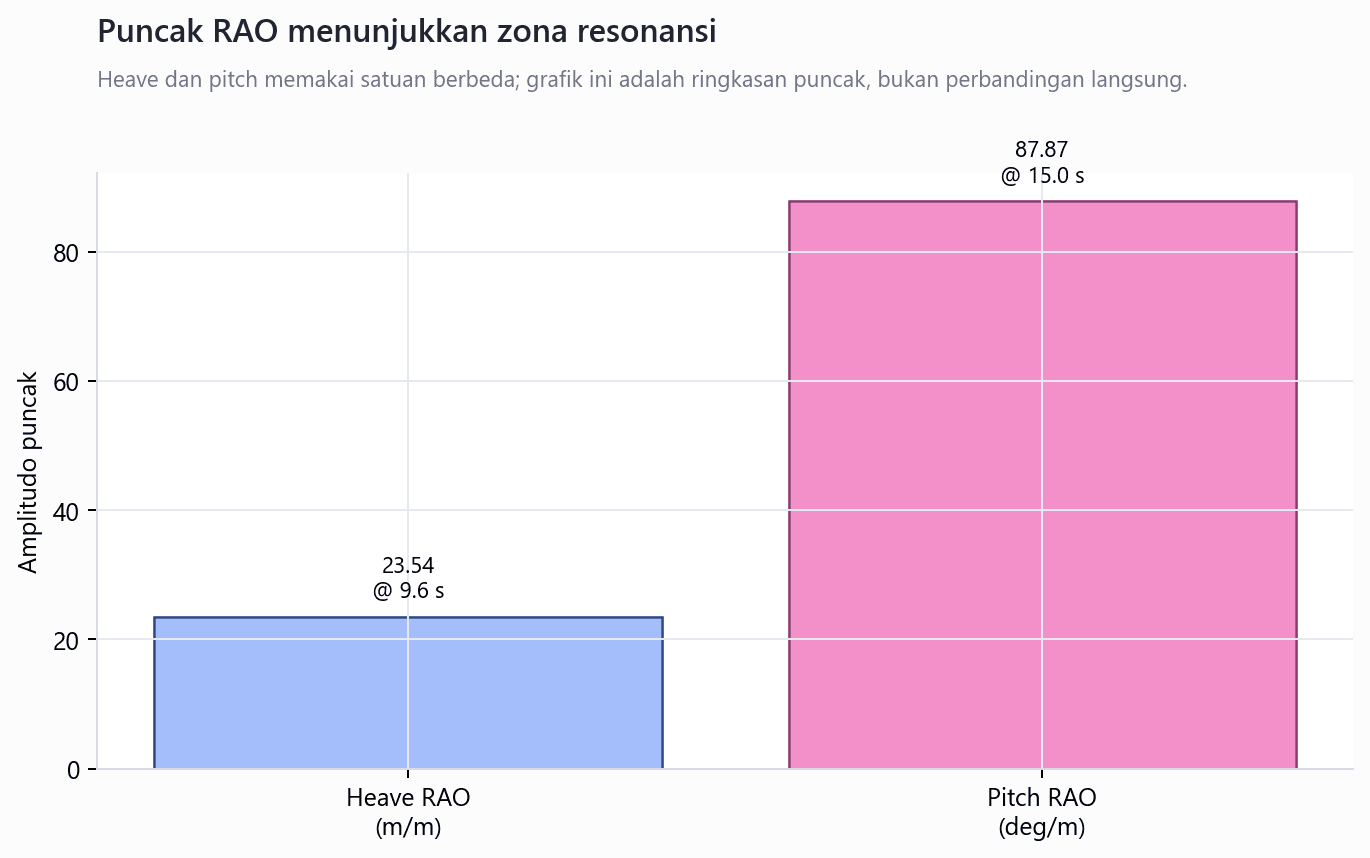
| Diffraction / RAO | 175 displacement points; heave peak 23.5389 m/m at 9.6 s | High response is a model sensitivity red flag, not an acceptance metric. |
| Fresh time response | 600 s, 6,001 records, Z-range warnings 0 | One realization only; multi-seed design statistics remain outside scope. |
Reported results
- The fresh irregular-wave run retained 6,001 records over 600 s at a 0.1 s output interval.
- The retained RAO summary contains 175 displacement points; peak values are shown as a learning-model sensitivity result, not a design acceptance criterion.
- The Z-range warning count changed from 156 to 0 after the copied-deck range adjustment; mean line tension remained about 92.98 kN in the stated model context.
Key takeaways
- A solver exit code is not enough: hydrostatic, buoyancy, and mooring-database warnings must remain visible beside the response plots.
- The range correction made a fresh time-response run possible, but it did not remove the remaining model-basis caveats.
Interpretation boundary
SPAR-type simulation, rerun evidence, and disclosed warning review. The specific limitations below remain part of the case, not footnotes.
Limitations
- Student engineering study for learning and portfolio purposes; it is not a certified design deliverable.
- The study does not provide code compliance, final fatigue or buckling, a complete metocean design basis, or multi-seed 100-year extreme statistics.
What I learned
- Treat the warning register as a first-class engineering output.
- Use copied decks and hashes when a reproducibility exercise must preserve original reference material.
Evidence trail
Final engineering learning reportVerified retained report
AQWA reproducibility reportVerified retained report
Fresh time-response verificationVerified output